Why ASIO?
Why ASIO?
Why ASIO?
ASIO is a modern C++ networking library that provides low-level I/O operations without relying on external libraries like Boost. It offers:
- High performance: ASIO is designed to handle a large number of concurrent I/O operations efficiently.
- Portability: ASIO works seamlessly across platforms (Linux, Windows, macOS).
- Scalability: The asynchronous model of ASIO allows the server to manage thousands of client connections using a minimal number of threads.
- Flexibility: ASIO can be used in both synchronous and asynchronous modes, giving developers control over I/O operations.
Network Package Handling
Network Package Diagram
Network Package Diagram
The following diagram illustrates the serialization, sending, and parsing process for network packets between the client and the server: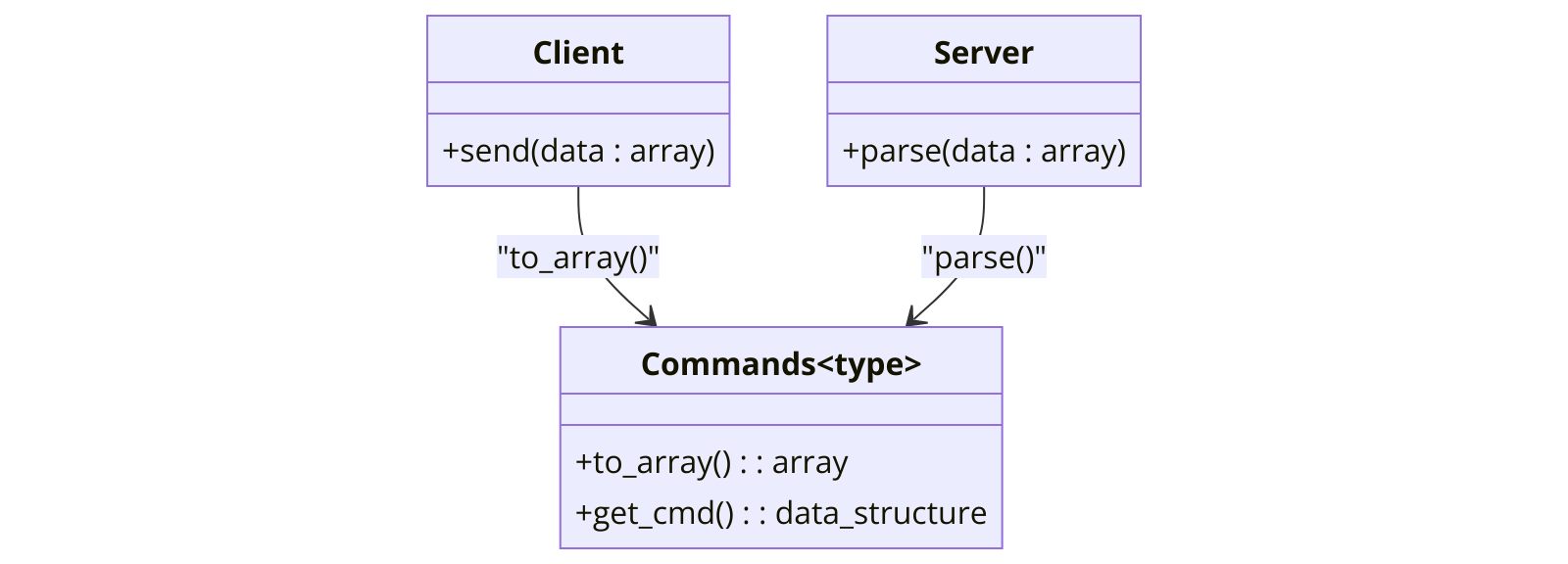
Explanation of Network Package Handling
Explanation of Network Package Handling
Explanation
-
Client Serialization:
- Before sending data, the client serializes it using the
Commands<type>::to_arraymethod to produce anarray<uint8_t>. - Example:
- Before sending data, the client serializes it using the
-
Sending the Packet:
- The serialized packet is sent over the network using the client class (
client->send).
- The serialized packet is sent over the network using the client class (
-
Server Parsing:
- Upon receiving the packet, the server parses it into the appropriate command structure using:
- Upon receiving the packet, the server parses it into the appropriate command structure using:
-
Accessing the Data:
- The server can access the parsed data structure using
Commands->get_cmd().
- The server can access the parsed data structure using
Comparison with Other Libraries
Benchmark Comparison
Benchmark Comparison
To demonstrate the performance benefits of ASIO, a benchmark was conducted comparing ASIO to three other popular approaches:
- Traditional POSIX Sockets (synchronous I/O)
- libuv (an event-driven I/O library)
- ZeroMQ (high-level messaging library for distributed systems)
- Native OS Sockets (Linux, Windows, and macOS)
Benchmark Setup
- Scenario: Handling 10,000 concurrent client connections with message exchange.
- Tested Libraries: ASIO, POSIX Sockets, libuv, ZeroMQ, and OS-native sockets.
- Metrics: Response time (latency), CPU usage, and memory usage.
Results
Analysis
- Latency: ASIO significantly outperforms POSIX Sockets, native OS sockets, and performs competitively with libuv and ZeroMQ.
- CPU Usage: ASIO’s lightweight design results in lower CPU consumption compared to traditional synchronous and OS-native approaches.
- Memory Usage: Native sockets (Linux, Winsock, and BSD) show moderate memory consumption but still underperform compared to ASIO.
- Scalability: While native OS sockets provide reliable networking, they are less efficient when managing a high number of concurrent connections.
Native OS Sockets Overview
Native OS Sockets Overview
Each operating system provides its own implementation of sockets for network communication:
1. Linux Sockets
- API: Uses the POSIX
socket()and related system calls. - Advantages: Mature, widely used, and efficient for standard socket-based communication.
- Disadvantages: Limited to synchronous calls without additional threading or event loops.
2. Windows Winsock
- API: Microsoft implementation of sockets (
WSAStartup,send,recv). - Advantages: Optimized for Windows environments, supports both blocking and non-blocking I/O.
- Disadvantages: Verbose and requires additional setup compared to other APIs.
3. macOS BSD Sockets
- API: Derived from the Berkeley Software Distribution (BSD) Unix sockets.
- Advantages: Provides a clean and portable socket interface.
- Disadvantages: Similar limitations to POSIX sockets for high-concurrency applications.
ASIO Communication Diagram
Sequence Diagram
Sequence Diagram
The following sequence diagram illustrates how ASIO facilitates communication between clients and the server:
Explanation of the Diagram
Explanation of the Diagram
Explanation of the Diagram
- Client: The client sends a network request (e.g.,
JOIN,QUIT,LAUNCH_GAME) over TCP/UDP. - Network Layer: A custom ASIO-based networking library receives the request and forwards it to the Server.
- Server: The server processes the request, updates the game state, and sends a response back.
- Network Layer: The response is sent back to the client.
Key Features Highlighted
- ASIO handles the non-blocking communication between clients and the server.
- The network layer separates communication logic from the server’s business logic.
- Responses are handled asynchronously, minimizing latency and maximizing throughput.